📌 What is Caste Affidavit Form-3 with Family Tree - Rule 4(1) Genealogy Affidavit?
Form-3 Affidavit is the substantive legal affidavit required for caste certificate scrutiny applications in Maharashtra and other states following similar caste verification rules. It is prescribed under Rule 4(1) of the relevant State Caste Certificate Rules, in conjunction with Rule 4 and Order 18 of the Code of Civil Procedure, 1908. Unlike Form-17 (which is a simpler identity affidavit), Form-3 contains the detailed genealogical information about the applicant family lineage — making it the most important document in the entire caste scrutiny package.
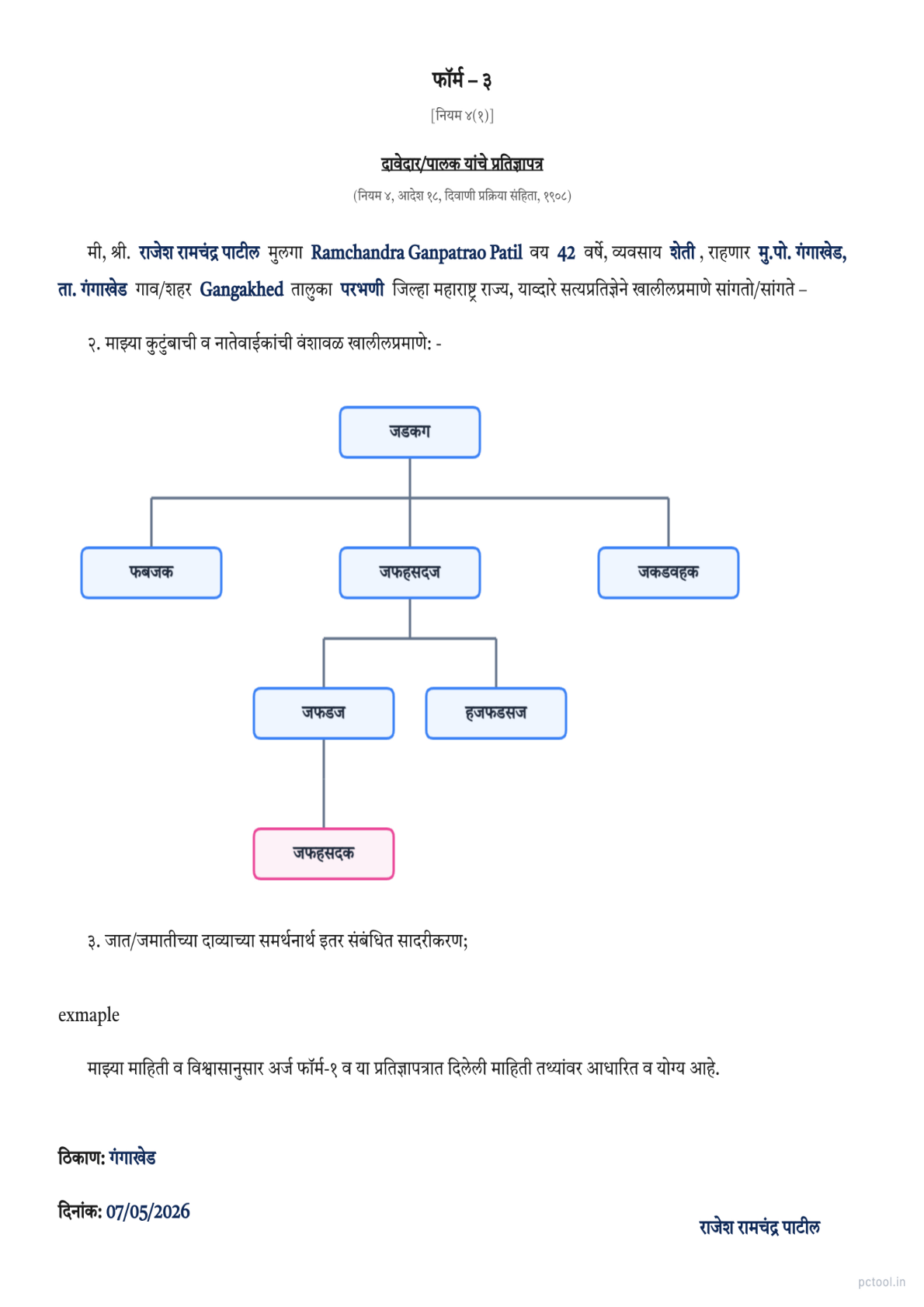
The defining feature of Form-3 is the inclusion of a comprehensive family tree (genealogy) showing the applicant ancestry — typically going back at least three generations. Caste in most Indian communities is traced through paternal lineage, so the family tree shows the applicant, father, grandfather, great-grandfather, and their respective siblings and spouses where relevant. The applicant is typically underlined or highlighted in the tree to make identification easy for the scrutiny committee. The tree must accurately represent all known ancestors and descendants in the paternal line because any inconsistency or gap can lead to rejection of the caste claim.
Our Form-3 Affidavit tool combines two powerful features in one workspace — the affidavit form on the left and an integrated family tree builder on the right. Switch between the form and the tree using tabs. The form captures applicant details including name, father name, age, occupation, address, tahsil, and district. The family tree builder lets you add the root ancestor, build down through generations with multiple spouses and children, and underline the applicant name to mark their position in the lineage. The tree is automatically embedded into the generated PDF.
This is a premium tool (5 coins per PDF download) because of the integrated affidavit and family tree workflow, the high-resolution PDF generation that includes the embedded genealogy, and the canvas-based family tree builder with full undo/redo support. Both Marathi and English versions are supported.
All processing runs entirely in your browser. The applicant personal details, family lineage information, and the generated affidavit never leave your device. This is critical given the sensitive caste-related and personal nature of the data.
❓ How to Use This Tool
Generating a Form-3 Affidavit with embedded family tree takes about 10 to 20 minutes. Here is the complete process.
Step 1: Choose Language
Click Marathi or English at the top right. Marathi is required for caste certificate scrutiny applications in Maharashtra. English may be used for higher courts and central institutions but the standard is Marathi.
Step 2: Fill Applicant Information (Form Tab)
On the Form tab, enter the title (Shri/Smt./Kumari), full name, son or daughter designation, father full name, age, occupation, village or town, tahsil, and district. The applicant name and father name must match exactly with the original caste certificate, school records, and other supporting documents.
Step 3: Optional Para 3 Other Submissions
The Para 3 field accepts additional submissions you want to include in the affidavit — such as references to existing caste certificates of relatives, court orders supporting the caste claim, or any other relevant declarations. This field is optional.
Step 4: Set Date and Place
Enter the current date and place where the affidavit is being signed.
Step 5: Switch to Family Tree Tab
Click the Family Tree tab to enter the genealogy builder. The right panel switches from the affidavit preview to a canvas where you build the tree.
Step 6: Add the Root Ancestor
Type the name of the oldest known male ancestor — typically the great-grandfather of the applicant. Select male gender and click Add Root Ancestor. This person becomes the root of the family tree.
Step 7: Build the Paternal Lineage
Select the root and add their spouse (the applicant great-grandmother). Add the children (one of whom is the applicant grandfather). Continue down the lineage — grandfather, his spouse, their children including the applicant father, the applicant father spouse (the applicant mother), and finally the applicant themselves and any siblings.
Step 8: Underline the Applicant Name
Select the applicant in the tree and click the U (underline) button. The applicant name appears underlined in the tree, making it easy for the scrutiny committee to identify the person whose caste is being verified.
Step 9: Adjust Layout
Drag any nodes to reposition them if the auto-layout is not optimal. Ensure the tree clearly shows the descent from the root ancestor down to the applicant.
Step 10: Switch Back to Form Tab and Download
Click the Form tab to return to the affidavit. The family tree image is automatically embedded in the affidavit PDF. Click Download PDF to generate the complete print-ready Form-3 affidavit with the embedded genealogy.
Step 11: Execute on Stamp Paper
Print on standard A4 paper, take to a notary or magistrate, execute on appropriate stamp paper as required by the scrutiny committee, and submit along with Form-17 and the complete scrutiny application.
✓ Features & Benefits
- Official Form-3 format under Rule 4(1) of State Caste Certificate Rules
- Integrated family tree builder with the affidavit form in one workspace
- Automatically embedded family tree image in the generated PDF
- Underline feature to mark the applicant name in the genealogy
- Multi-generational tree support with multiple spouses per person
- Marathi and English language toggle with one click
- Live preview of the affidavit document as you fill the form
- Authentic Tiro Devanagari Marathi font for proper Marathi rendering
- Drag-to-reposition for fine-tuning tree layout
- Print-ready A4 PDF output ready for stamp paper execution
- 100% browser-based — sensitive caste lineage data never leaves your device
- Supports SC, ST, OBC, NT, VJNT, SBC, and all reserved category certificates
💡 Tips for Best Results
For the family tree, always start with the oldest male ancestor known in the paternal line — typically the great-grandfather or earlier. Caste in most Indian communities flows through male lineage, so the paternal line is the focus of scrutiny. Female members should be included where relevant but the descent line traces through fathers and grandfathers.
Underline the applicant name in the family tree using the U button. This is critical — the scrutiny committee scans hundreds of trees and easily identifying the applicant speeds up review significantly. Many applications get returned for missing the underline.
The names in the family tree must match the names in supporting documents. For ancestors deceased decades ago, names may have spelling variations across old school records, land records, and church or temple registers. Use the most commonly recorded version, and attach an additional name affidavit if multiple variations exist.
Form-3 must always be executed on stamp paper of the value required by your specific District Caste Certificate Scrutiny Committee. The standard requirement is Rs. 100 to Rs. 500 non-judicial stamp paper. Verify the exact requirement with your committee.
Get Form-3 notarized or attested by an executive magistrate or a gazetted officer as per the committee instructions. Without proper attestation, the affidavit will be rejected.
Submit Form-3 along with Form-17, the original caste certificate, school records of the applicant and ancestors (where available), village panchayat records, voter ID copies of family members, and any other documents that support the caste claim. The complete package is what the committee evaluates.
Caste scrutiny is mandatory for educational admissions to professional courses, government jobs in reserved categories, election contests for reserved seats, and several other purposes. Apply for scrutiny at least 3 to 6 months in advance of when you need the verified certificate.
For complex cases — adopted children, conversion to or from another religion in the lineage, inter-caste marriages affecting the descent line — consult with a lawyer experienced in caste scrutiny matters before finalizing the family tree. Errors at this stage are difficult to correct later.
Submitting false information in Form-3 is a serious criminal offence under Sections 191, 192, and 193 of the Indian Penal Code, and the State Caste Certificate Rules. Penalties include imprisonment, fine, cancellation of the caste certificate, and reversal of all benefits derived from it.
❔ Frequently Asked Questions
What is Form-3 Affidavit?
Form-3 is the substantive legal affidavit required for caste certificate scrutiny applications. Prescribed under Rule 4(1) of State Caste Certificate Rules, it contains detailed genealogical information including a family tree showing the applicant ancestry through the paternal line. It is the most important document in the scrutiny package.
How is Form-3 different from Form-17?
Form-17 is a simpler identity affidavit confirming the applicant identity and certificate details. Form-3 is the substantive affidavit with the family tree and detailed lineage information. Both are typically required together for a complete scrutiny application — Form-3 is far more detailed and important.
Why is the family tree included in Form-3?
Caste in most Indian communities is traced through paternal lineage. The family tree allows the scrutiny committee to verify that the applicant descends from a verified caste line. The tree must show ancestors in the paternal line typically going back at least three generations. Without the tree, the caste claim cannot be properly verified.
Why should I underline the applicant name in the tree?
Underlining clearly marks the applicant in the genealogy, making it easy for the scrutiny committee to identify the person whose caste is being verified. Many applications get returned for missing this critical detail. The U button in the tree builder applies the underline automatically.
How many generations should the family tree cover?
Typically at least three generations going back from the applicant — applicant, father, grandfather, great-grandfather. Some scrutiny committees require deeper genealogy in disputed cases. Include all known male ancestors in the paternal line and their spouses and children.
On what stamp paper should Form-3 be executed?
Standard requirement is Rs. 100 to Rs. 500 non-judicial stamp paper depending on your specific District Caste Certificate Scrutiny Committee. The stamp paper must be in the applicant name. Verify the exact requirement with your committee before purchasing the stamp paper.
What happens if I make an error in the family tree?
Errors in the family tree can lead to rejection of the entire scrutiny application. Common errors include missing ancestors, incorrect descent lines, wrong spouse attribution, and missing underline of the applicant. For complex cases, consult a lawyer experienced in caste scrutiny matters. Use the undo feature in the tree builder freely while constructing.
Why does this tool cost 5 coins?
The premium pricing covers the integrated affidavit form and family tree builder, the high-resolution PDF generation that embeds the family tree, the canvas-based tree rendering with multi-generational layout algorithms, and the underline support. The first PDF download uses 5 coins.
📌 जात पडताळणी फॉर्म-३ वंशावळ सह - Genealogy Affidavit Format काय आहे?
फॉर्म-३ Affidavit (Form-3) हे महाराष्ट्र आणि similar caste verification rules पाळणाऱ्या इतर राज्यांत जात प्रमाणपत्र पडताळणी अर्जांसाठी आवश्यक substantive कायदेशीर प्रतिज्ञापत्र आहे. हे संबंधित State Caste Certificate Rules च्या नियम ४(१) अंतर्गत निर्धारित आहे — Code of Civil Procedure, 1908 च्या नियम ४ आणि आदेश १८ शी संयोगात. फॉर्म-१७ (साधे identity affidavit) च्या उलट, फॉर्म-३ मध्ये अर्जदाराच्या कुटुंब वंशाबद्दल detailed genealogical माहिती असते — यामुळे संपूर्ण caste scrutiny package मधील सर्वात महत्त्वाचे document.
फॉर्म-३ चे defining वैशिष्ट्य म्हणजे comprehensive वंशावळ (family tree) समाविष्ट आहे — अर्जदाराच्या ancestry दर्शविणारी, साधारणपणे किमान तीन पिढ्या मागे जाणारी. बहुतेक भारतीय समाजांमध्ये जात paternal lineage द्वारे trace होते, त्यामुळे family tree अर्जदार, वडील, आजोबा, पणजोबा, आणि त्यांचे संबंधित भावंडे आणि जोडीदार दर्शवते. Scrutiny committee ला identification सोपे करण्यासाठी अर्जदाराला साधारणपणे tree मध्ये underline किंवा highlight केले जाते. Tree paternal line मधील सर्व ज्ञात पूर्वज आणि वंशजांचे accurate representation असले पाहिजे — कोणतीही inconsistency किंवा gap जात दावा rejection कारणीभूत होऊ शकते.
आमचे फॉर्म-३ Affidavit टूल एकाच workspace मध्ये दोन powerful वैशिष्ट्ये combine करते — डाव्या बाजूला affidavit form आणि उजव्या बाजूला integrated family tree builder. Tabs वापरून form आणि tree मध्ये switch करा. Form अर्जदाराचे तपशील capture करते — नाव, वडिलांचे नाव, वय, व्यवसाय, पत्ता, तहसील, आणि जिल्हा. Family tree builder root पूर्वज जोडण्यास, multiple spouses आणि मुलांसह पिढ्यांमधून खाली build करण्यास, आणि lineage मधील अर्जदाराची position mark करण्यासाठी अर्जदाराचे नाव underline करण्यास सक्षम करते. Tree generated PDF मध्ये automatically embed होते.
हे premium टूल आहे (प्रत्येक PDF download साठी 5 coins) — integrated affidavit आणि family tree workflow, embedded genealogy सह high-resolution PDF generation, आणि full undo/redo support सह canvas-based family tree builder मुळे. मराठी आणि English दोन्ही versions support.
सर्व प्रक्रिया ब्राउझरमध्येच होते. अर्जदाराचे वैयक्तिक तपशील, family lineage माहिती, आणि generated affidavit कधीही device सोडत नाहीत. Data च्या संवेदनशील caste-संबंधित आणि वैयक्तिक स्वरूपामुळे हे critical आहे.
❓ हे साधन कसे वापरावे
पायरी १: भाषा निवडा
उजव्या वरच्या कोपऱ्यातील मराठी किंवा English क्लिक करा. महाराष्ट्रातील जात प्रमाणपत्र पडताळणी अर्जांसाठी मराठी आवश्यक. उच्च न्यायालये आणि केंद्रीय संस्थांसाठी English वापरता येते पण standard मराठी आहे.
पायरी २: अर्जदाराची माहिती भरा (Form Tab)
Form tab वर पदवी (Shri/Smt./Kumari), संपूर्ण नाव, son किंवा daughter designation, वडिलांचे संपूर्ण नाव, वय, व्यवसाय, गाव किंवा शहर, तहसील, आणि जिल्हा टाका. अर्जदाराचे नाव आणि वडिलांचे नाव मूळ जात प्रमाणपत्र, शाळेच्या records, आणि इतर supporting documents यांच्याशी exactly match असावे.
पायरी ३: ऐच्छिक Para 3 Other Submissions
Para 3 field affidavit मध्ये समाविष्ट करायच्या अतिरिक्त submissions स्वीकारते — जसे की नातेवाईकांच्या existing caste certificates चे references, जात दावा support करणारे court orders, किंवा कोणतेही relevant declarations. हे field ऐच्छिक.
पायरी ४: दिनांक आणि ठिकाण सेट करा
Affidavit सही करण्याची current date आणि ठिकाण टाका.
पायरी ५: Family Tree Tab वर switch करा
Genealogy builder मध्ये जाण्यासाठी Family Tree tab क्लिक करा. Right panel affidavit preview वरून tree build करण्याच्या canvas वर switch होते.
पायरी ६: मूळ पूर्वज जोडा
सर्वात जुन्या ज्ञात पुरुष पूर्वजाचे नाव टाका — साधारणपणे अर्जदाराचे पणजोबा. Male gender निवडा आणि Add Root Ancestor क्लिक करा. ही व्यक्ती family tree चे root होते.
पायरी ७: Paternal Lineage Build करा
Root ला select करा आणि त्यांची जोडीदार जोडा (अर्जदाराची पणजी). मुले जोडा (ज्यापैकी एक अर्जदाराचे आजोबा आहेत). Lineage खाली continue करा — आजोबा, त्यांची जोडीदार, त्यांची मुले अर्जदाराच्या वडिलांसह, अर्जदाराच्या वडिलांची जोडीदार (अर्जदाराची आई), आणि शेवटी अर्जदार स्वतः आणि कोणतेही भावंडे.
पायरी ८: अर्जदाराचे नाव Underline करा
Tree मधील अर्जदाराला select करा आणि U (underline) button क्लिक करा. Tree मध्ये अर्जदाराचे नाव underlined appear होते — scrutiny committee ला verify होणारी व्यक्ती ओळखणे सोपे.
पायरी ९: Layout Adjust करा
Auto-layout optimal नसल्यास कोणतेही nodes drag करून reposition करा. Tree मूळ पूर्वजापासून अर्जदारापर्यंत descent स्पष्टपणे दर्शवत आहे याची खात्री करा.
पायरी १०: Form Tab कडे परत switch करा आणि Download करा
Affidavit कडे परत येण्यासाठी Form tab क्लिक करा. Family tree image automatically affidavit PDF मध्ये embed होते. Embedded genealogy सह संपूर्ण print-ready फॉर्म-३ affidavit generate करण्यासाठी Download PDF क्लिक करा.
पायरी ११: Stamp Paper वर Execute करा
Standard A4 paper वर print करा, notary किंवा magistrate कडे न्या, scrutiny committee च्या आवश्यकतेनुसार योग्य stamp paper वर execute करा, आणि फॉर्म-१७ आणि संपूर्ण scrutiny अर्जासह सादर करा.
✓ वैशिष्ट्ये आणि फायदे
- State Caste Certificate Rules च्या नियम ४(१) अंतर्गत official Form-3 format
- एकाच workspace मध्ये affidavit form सह integrated family tree builder
- Generated PDF मध्ये automatically embedded family tree image
- Genealogy मध्ये अर्जदाराचे नाव mark करण्यासाठी Underline feature
- प्रति व्यक्ती multiple spouses सह multi-generational tree support
- मराठी आणि English एका क्लिकमध्ये toggle
- Form भरताना affidavit document चा live preview
- Devanagari rendering साठी authentic Tiro Devanagari Marathi font
- Tree layout fine-tuning साठी drag-to-reposition
- Stamp paper execution साठी ready print-ready A4 PDF
- १००% ब्राउझर-आधारित — संवेदनशील caste lineage data सर्व्हरवर जात नाही
- SC, ST, OBC, NT, VJNT, SBC, आणि सर्व आरक्षित श्रेणी प्रमाणपत्रांसाठी support
💡 सर्वोत्तम परिणामांसाठी टिपा
Family tree साठी नेहमी paternal line मधील सर्वात जुन्या ज्ञात पुरुष पूर्वजापासून सुरू करा — साधारणपणे पणजोबा किंवा त्याहून आधीचे. बहुतेक भारतीय समाजांमध्ये जात male lineage द्वारे flow होते, त्यामुळे paternal line scrutiny चा focus असतो. महिला सदस्यांचा relevant ठिकाणी समावेश करा पण descent line वडील आणि आजोबांमधून trace होते.
U button वापरून family tree मध्ये अर्जदाराचे नाव underline करा. हे critical — scrutiny committee शेकडो trees scan करते आणि अर्जदार easily ओळखणे review significantly जलद करते. Underline missing असल्यामुळे अनेक applications परत येतात.
Family tree मधील नावे supporting documents मधील नावांशी match असावीत. दशकांपूर्वी मयत पूर्वजांसाठी, जुन्या शाळेच्या records, जमिनीच्या records, आणि चर्च किंवा मंदिर registers मध्ये नावांच्या spelling variations असू शकतात. सर्वात commonly recorded version वापरा, आणि multiple variations असल्यास additional name affidavit जोडा.
फॉर्म-३ नेहमी तुमच्या specific जिल्हा जात प्रमाणपत्र पडताळणी समितीने आवश्यक केलेल्या value च्या stamp paper वर execute करावे. Standard requirement रु. १०० ते रु. ५०० non-judicial stamp paper. Exact requirement तुमच्या committee सह verify करा.
Committee च्या सूचनेनुसार फॉर्म-३ notarized किंवा executive magistrate किंवा gazetted officer कडून attested करा. Proper attestation शिवाय affidavit reject होईल.
फॉर्म-३ फॉर्म-१७, मूळ जात प्रमाणपत्र, अर्जदार आणि पूर्वजांच्या शाळेच्या records (जिथे उपलब्ध), village panchayat records, family members च्या voter ID copies, आणि जात दावा support करणारे इतर कोणतेही documents यांसह सादर करा. Complete package committee evaluate करते.
जात पडताळणी professional courses मधील शैक्षणिक प्रवेश, आरक्षित श्रेणींतील सरकारी नोकऱ्या, आरक्षित जागांसाठी निवडणूक, आणि इतर अनेक उद्देशांसाठी बंधनकारक. Verified certificate हवे त्या वेळेच्या किमान ३ ते ६ महिने आधी scrutiny साठी अर्ज करा.
Complex cases साठी — adopted children, lineage मधील दुसऱ्या धर्मात किंवा त्यापासून conversion, descent line वर परिणाम करणारे inter-caste विवाह — family tree finalize करण्यापूर्वी caste scrutiny matters मध्ये experienced lawyer सह सल्लामसलत करा. या stage वरील errors नंतर correct करणे कठीण.
फॉर्म-३ मध्ये खोटी माहिती सादर करणे भारतीय दंड संहितेच्या कलम १९१, १९२, आणि १९३, आणि State Caste Certificate Rules अंतर्गत गंभीर फौजदारी गुन्हा. Penalties मध्ये कारावास, दंड, जात प्रमाणपत्र cancellation, आणि त्यापासून मिळालेले सर्व benefits cancellation समाविष्ट.
❔ वारंवार विचारले जाणारे प्रश्न
फॉर्म-३ Affidavit म्हणजे काय?
फॉर्म-३ हे जात प्रमाणपत्र पडताळणी अर्जांसाठी आवश्यक substantive कायदेशीर प्रतिज्ञापत्र आहे. State Caste Certificate Rules च्या नियम ४(१) अंतर्गत निर्धारित — paternal line द्वारे अर्जदाराच्या ancestry दर्शविणाऱ्या family tree सह detailed genealogical माहिती असते. Scrutiny package मधील सर्वात महत्त्वाचे document.
फॉर्म-३ फॉर्म-१७ पासून कसे वेगळे आहे?
फॉर्म-१७ अर्जदाराची identity आणि प्रमाणपत्र तपशील confirm करणारे simpler identity affidavit. फॉर्म-३ family tree आणि detailed lineage माहिती सह substantive affidavit. संपूर्ण scrutiny अर्जासाठी दोन्ही एकत्र साधारणपणे आवश्यक — फॉर्म-३ जास्त detailed आणि महत्त्वाचे.
फॉर्म-३ मध्ये family tree का समाविष्ट आहे?
बहुतेक भारतीय समाजांमध्ये जात paternal lineage द्वारे trace होते. Family tree scrutiny committee ला verify करण्याची सुविधा देते की अर्जदार verified जात line पासून descend होतो. Tree मध्ये paternal line मधील पूर्वज साधारणपणे किमान तीन पिढ्या मागे जातात. Tree शिवाय जात दावा properly verify करता येत नाही.
Tree मध्ये अर्जदाराचे नाव underline का करावे?
Underlining genealogy मध्ये अर्जदार स्पष्टपणे mark करते — scrutiny committee ला verify होणारी व्यक्ती identify करणे सोपे होते. हे critical detail missing असल्यामुळे अनेक applications परत येतात. Tree builder मधील U button automatic underline लागू करते.
Family tree किती पिढ्या cover करावा?
अर्जदारापासून मागे साधारणपणे किमान तीन पिढ्या — अर्जदार, वडील, आजोबा, पणजोबा. काही scrutiny committees disputed cases मध्ये deeper genealogy मागतात. Paternal line मधील सर्व ज्ञात पुरुष पूर्वज आणि त्यांचे जोडीदार आणि मुले समाविष्ट करा.
फॉर्म-३ कोणत्या stamp paper वर execute करावे?
Standard requirement तुमच्या specific जिल्हा जात प्रमाणपत्र पडताळणी समितीनुसार रु. १०० ते रु. ५०० non-judicial stamp paper. Stamp paper अर्जदाराच्या नावावर असावे. Stamp paper खरेदी करण्यापूर्वी exact requirement तुमच्या committee सह verify करा.
Family tree मध्ये चूक झाली तर काय होते?
Family tree मधील errors संपूर्ण scrutiny अर्ज rejection कारणीभूत होऊ शकतात. Common errors मध्ये missing पूर्वज, चुकीच्या descent lines, चुकीचे spouse attribution, आणि अर्जदाराच्या नावाचे missing underline समाविष्ट. Complex cases साठी caste scrutiny matters मध्ये experienced lawyer कडे सल्लामसलत करा. Construction दरम्यान tree builder मधील undo feature मोकळेपणाने वापरा.
या टूल साठी 5 coins का लागतात?
Premium pricing integrated affidavit form आणि family tree builder, family tree embed करणारी high-resolution PDF generation, multi-generational layout algorithms सह canvas-based tree rendering, आणि underline support यांना cover करते. पहिले PDF download 5 coins वापरते.